


Heavy-Duty Marine Launching Airbags & Inflatable Rubber Roller Bags

Product Overview & Structural Composition
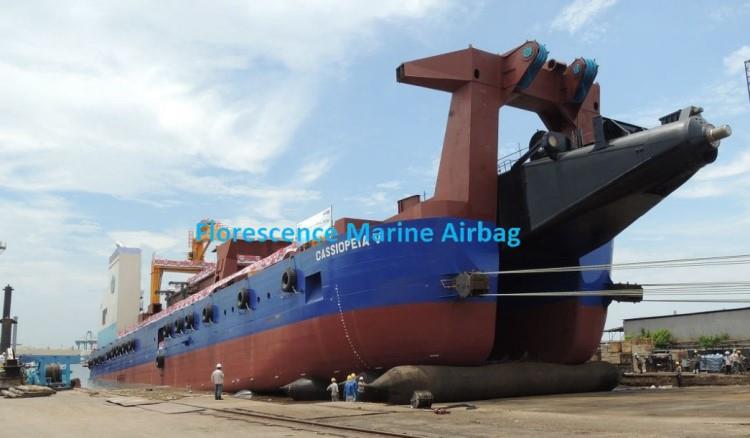
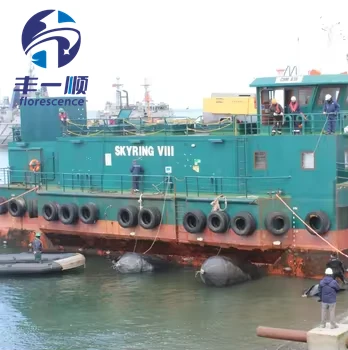
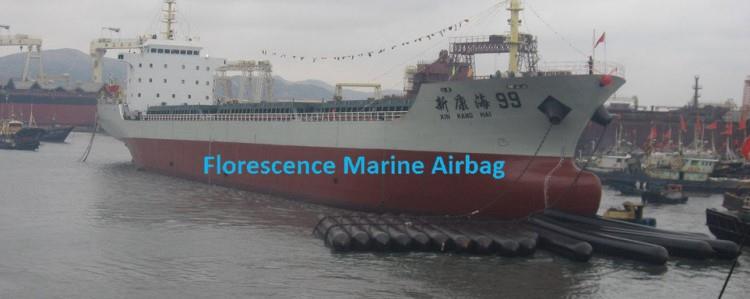
FLORESCENCE Heavy-Duty Marine Launching Airbags (also globally recognized as ship launching inflatable roller bags, rubber pontoons, marine air balloons, or vessel docking airbags) are highly engineered, flexible pneumatic hoisting and rolling systems. They serve as the primary safe-handling medium for ship launching, dry-docking, heavy lifting, and marine salvage operations worldwide.
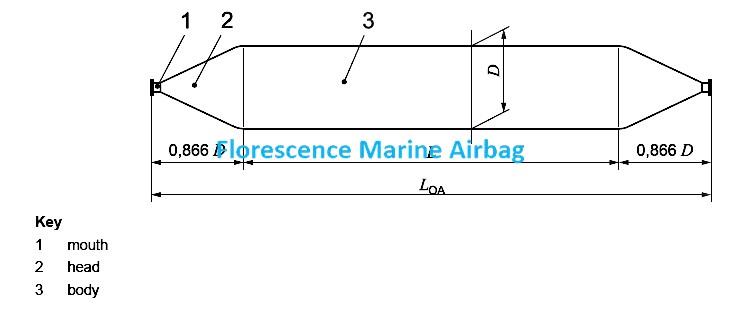
Each airbag is integrated into a seamless structural assembly consisting of two primary segments:
The Airbag Core Body: Manufactured utilizing high-grade natural rubber formulations cross-layered with high-tensile synthetic-tire-cord (nylon cord) reinforcement materials, treated via advanced high-pressure vulcanization processing.
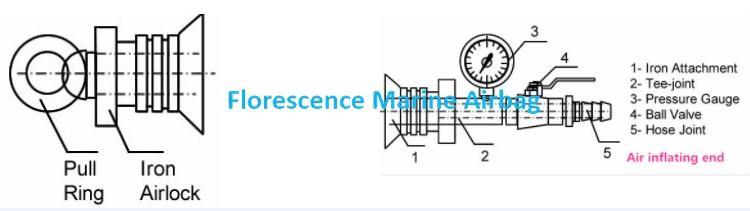
The End-Terminal Cast Iron Assembly: Securely bonded and sealed to both ends of the rubber body. One end is fitted with an ultra-strong pulling ring used for maneuvering, positioning, and safety rigging. The opposing end functions as the dedicated pneumatic manifold for precise inflation, deflation, and real-time internal pressure monitoring.
Key Engineering Features & Performance Advantages
Extreme Inflation & Torsional Pressure Resistance: When positioned underneath a ship's hull, airbags undergo massive compression, squeezing forces, and uneven angular stress. Due to asymmetric rolling speeds over changing slipway grades, airbags naturally experience helical twisting. FLORESCENCE airbags are engineered with specialized interlocking cord layers to withstand severe structural distortion while retaining uniform internal pressure stability.
Elite Abrasion, Anti-Aging & Corrosion Resistance: Marine airbags operate under severe environmental conditions, directly exposed to raw sunlight (UV radiation), saltwater, coarse abrasive sand, sharp rocks, mud, and chemical hydrocarbons. Our premium natural rubber matrix contains proprietary chemical stabilizers that resist ozone degradation, rubber embrittlement, and structural wear.
Hydrodynamic & Structural Modeling Optimization: The structural layout, ply-matrix angles, and internal fiber orientations have been rigorously modeled using finite element strength analysis and verified through destructive burst testing to ensure the highest safety factors under maximum displacement loads.
Technical Specification Matrix
| Parameter Category | Standard Engineering Range |
| Primary Materials | Premium Grade Malaysian Natural Rubber & High-Tensile Nylon Cord Plies |
| Standard Ply Layers | 3 Plies to 12 Plies (Custom heavy plies available for deep-water salvage) |
| Diameter Scope (Dia) | ø0.6m to ø2.8m |
| Effective Length Scope (Len) | 5.0m to 25.0m |
| Operational Service Life | 6 to 8 Years (Subject to correct storage and operating parameters) |
| Standard Rigging Fittings | Calibrated pressure gauge, high-strength pulling ring, three-way connecting manifold, and air-tight control valves |
| International Certificates | Full Type-Approval by CCS, BV, ABS, RS, IRS, and compliant with ISO 14409 |

Airbag Deployment & Layout Configurations for Vessel Launching
Choosing the correct airbag arrangement layout is critical to maintaining horizontal hull stability during slipway rolling. The layout pattern is primarily governed by the vessel's beam (width) and the effective rolling length of the selected airbag:
1. Linear Arrangement - Operational Criteria: Selected when the vessel beam is less than or equal to the effective length of a single airbag. - Example Scenario: If the ship's beam is 15 meters, and the airbag's effective length exceeds 15 meters, the airbags are arranged in a single continuous linear row directly perpendicular to the keel line.
2. Staggered Arrangement- Operational Criteria: Selected when the vessel beam is wider than a single airbag's effective length, but not wide enough to justify two parallel lines. - Example Scenario: If the ship's beam is 18 meters, and the available airbags have an effective length of 13 meters, the units are arranged in an alternating, interlocking staggered pattern to ensure total center-to-edge support.
3. Two-Line Parallel Arrangement - Operational Criteria: Selected for wide-beam mega-vessels, where the ship width requires two separate, side-by-side rows of airbags running down parallel paths. - Example Scenario: If the ship's beam expands to 26 meters, and your airbags are 13 meters in length, a two-line arrangement is deployed with an open lane along the vessel's centerline axis.

Technical Design Input Questionnaire
To calculate the precise airbag diameter, effective length, mandatory ply layers, and total required quantities for a safe launch or docking sequence, please provide our engineering department with the following data parameters:
1. Main Vessel Dimensions: Total Length Over All (LOA), Breadth / Beam, and Lightship Weight (or actual launching weight).
2. Slipway / Ground Condition: What type of ground is the ship built on? (e.g., concrete slipway, compacted sand, reinforced gravel, natural shoreline slope).
3. Vessel Type: Cargo ship, chemical tanker, barge, tugboat, naval vessel, or offshore structure.
4. Hydrographic Depth: The actual water depth (in meters) at the drop-off zone where the vessel first enters the water from the slipway edge.
5. Operational Clear Working Height: The clearance height of the block stands currently supporting the keel underneath the ship.
Note: If available, please submit topographic site photos or profile drawings of your launch/slipway area to info13@florescence.cc for advanced engineering validation.
Why Partner with FLORESCENCE?
25+ Years of Marine Engineering Expertise: Since our establishment, we have served as a trusted, approved military navy supplier, engineering heavy-duty ground tackle and pneumatic systems that perform under high stakes.
Uncompromising IACS Certification Quality: Fully type-certified by the world's most rigorous classification societies (CCS, BV, ABS, etc.).
Strict Raw Material Inspection Control: Every batch of natural rubber and high-tensile nylon cord undergoes internal tensile, elongation, and vulcanization tests before entering the production line.
Global Logistics & Stock Availability: Capitalizing on our massive factory scale, we maintain active inventory pipelines of standard sizes, enabling rapid dispatch with ultra-short manufacturing lead times for urgent shipyard emergencies.
Marine Airbag FAQ
Applications & Materials
Q1: What are marine airbags mainly used for?
A: Ship launching and landing (dry-docking), heavy cargo transport, marine salvage, and floating infrastructure construction projects.
Q2: What materials are used in your marine airbags?
A: High-tensile synthetic tire-cord layers (for internal reinforcement) matrixed with premium, abrasion-resistant natural rubber.
Q3: How many layers are available for airbags?
A: Standard configurations range from 3 to 12 layers depending on your target working pressure and vessel weight requirements.
Customization & Capacity
Q4: Can airbags be customized?
A: Yes. We fully customize the diameter, effective length, internal pressure rating, reinforcement ply layers, and end-terminal structures to match your specific shipyard needs.
Q5: How is airbag bearing capacity calculated?
A: It is determined by the airbag's diameter, internal working pressure, contact area with the hull, total vessel weight, and the quantity of airbags deployed.
Maintenance & Value
Q6: How should marine airbags be stored?
A: Store them in a dry, well-ventilated indoor environment. Keep them completely away from direct sunlight, heat sources, oils, acids, and sharp objects.
Q7: Are repair services available for damaged airbags?
A: Yes. We provide specialized raw materials, complete repair kits, and step-by-step technical guidance to fix minor punctures and surface wear safely.
Q8: What advantages do marine airbags offer compared with traditional slipways?
A: Airbags dramatically lower infrastructure costs, allow flexible launching locations without fixed docks, are highly reusable, and are easily transported to turn any coastline into a temporary shipyard.
Hot Tags: ship launching inflatable roller bag, China, suppliers, manufacturers, factory, price, ship launching coastal airbag, vessel launching offshore equipment, ship launching inflatable airbag, marine airbag for flexible launching, ship launching durable airbag, vessel launching waterproof equipment


