


Hydro-Pneumatic Submarine Fenders & Submerged Hull Protection Systems

Product Overview
FLORESCENCE Hydro-Pneumatic Submarine Fenders are highly specialized, high-performance marine fendering systems engineered specifically for vessels and offshore structures whose primary contact zones reside deep below the waterline. Unlike standard surface pneumatic rubber fenders, these systems provide critical, damage-free collision protection for submarines, naval underwater vehicles, catamarans, semi-submersible platforms, and offshore drilling rigs.
By deploying a unique dual-medium internal ballast architecture, these fenders eliminate the risk of upward lifting or riding, protecting the sensitive, thin-skinned hydrodynamic hulls of submerged naval vessels during berthing or ship-to-ship (STS) transfers.
Working Principle & Technical Advantages
Dynamic Water-Air Ballast Architecture: The core hull of the hydro-pneumatic fender is partially ballasted with water and then pressurized with compressed air. An internal bottom counterweight ensures the fender constantly maintains a perfect vertical orientation in the water column, aligning precisely with the submerged hull profile.
Adjustable Draft & Performance Metrics: By dynamically altering the internal water-to-air ratio and fine-tuning the inflation pressure, engineering teams can precisely adjust the fender's draft, buoyancy index, and stiffness to match different submarine classes and freeboard heights.
High Energy Absorption with Ultra-Low Reaction Force: Engineered to prevent localized structural deflection or acoustic tile damage on naval hulls. The compressed air cushion absorbs massive kinetic mooring energy while exerting low, evenly distributed linear reaction forces.
10+ Years Marine-Grade Durability: Manufactured from high-tensile synthetic-tire-cord reinforcement layers and thick, ocean-grade vulcanized rubber, ensuring a rugged operational lifespan exceeding 10 years in corrosive saltwater environments.
Versatile Structural Configurations: Available in two distinct structural frameworks to meet diverse deployment criteria:
Sling-Type (Body Only): Minimalist design for lightweight handling and rapid deployment.
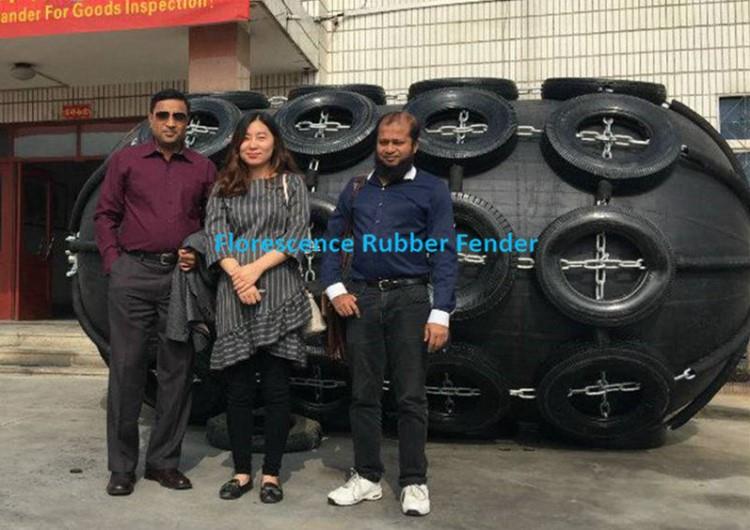
Chain-and-Tire Net (CTN) Type: Wrapped in a heavy-duty protective grid for extreme-friction environments and high shear loads.

Standard Engineering Dimensions & Scope
Our hydro-pneumatic manufacturing line supports a broad dimension matrix tailored for global naval defense and offshore energy sectors:
Minimum Dimension Capability: 0.5m Diameter × 1.0m Length (Ideal for small submersibles and coastal workboats).
Maximum Dimension Capability: 4.5m Diameter × 9.0m Length (Engineered for strategic ballistic missile submarines and deep-water semi-submersible drilling rigs).
Customized Engineering: Custom technical profiles, non-standard lengths, and dedicated naval grey non-marking rubber formulations are available upon request.
Naval Procurement & Field Installation Case Study
Procurement Authority: Bangladesh Navy
Equipment Specifications: 2 Units of Heavy-Duty 2.0*4.0mHydro-Pneumatic Submarine Fenders.
Quality Assurance Protocol: The naval procurement delegation completed a comprehensive on-site factory audit and physical load-testing witness verification at our manufacturing facility prior to dispatch.
Engineering Technical Support: To guarantee operational safety, FLORESCENCE dispatched our General Manager and Senior Marine Engineer directly to Chittagong Port. Our team successfully supervised the water-ballast calibration, final air inflation, and initial vertical rigging deployment, ensuring full integration with the naval port's infrastructure.

FAQ
Q: Why can standard pneumatic rubber fenders not be used for submarine berthing, and why are hydro-pneumatic fenders required?
A: Standard pneumatic fenders are filled entirely with air, causing them to float high on the water's surface. However, a submarine's widest beam and critical contact points are located deep below the waterline. Standard fenders would allow the submarine's submerged hull to strike the quay wall underneath the fender. Hydro-pneumatic fenders solve this by replacing a portion of the internal air with water ballast and utilizing a bottom weight. This forces the fender to stand vertically and sit deep in the water column, placing the protective air cushion directly in line with the submarine's submerged structural frame.
Q: How do operators calibrate and control the draft of a hydro-pneumatic submarine fender on-site?
A: The draft and underwater profile of the fender are completely adjustable by manipulating the internal fluid dynamics. Operators use the built-in dual-flange valve system on the tapered end to pump a calculated volume of water into the fender to act as the primary negative buoyancy medium. Once the required depth/draft is achieved, compressed air is introduced to achieve the targeted internal working pressure. This flexibility allows a single fender to be recalibrated for various naval classes, from fast attack submarines to large fleet auxiliary tankers.
Q: What are the main differences between Sling-type and Chain-and-Tire Net (CTN) type submarine fenders regarding naval applications?
A: Sling-type hydro-pneumatic fenders feature a smooth, clean rubber body without any external netting, making them significantly lighter, easier to hoist, and highly recommended for naval operations where minimizing hull marking or protecting sensitive acoustic rubber coating tiles is a priority. Chain-and-Tire Net (CTN) type fenders wrap the rubber body in a heavy-duty protective chain matrix fitted with recycled tires. This adds an extra layer of structural protection against rough concrete quay walls, severe tidal abrasion, and high-shear rubbing during ship-to-ship (STS) offshore operations.



Hot Tags: hydro pneumatic submarine fender, China, suppliers, manufacturers, factory, price, port upkeep fender, shock absorbing fender, standard fender, impact-resistant fender, waterway traffic fender, berth fender


