

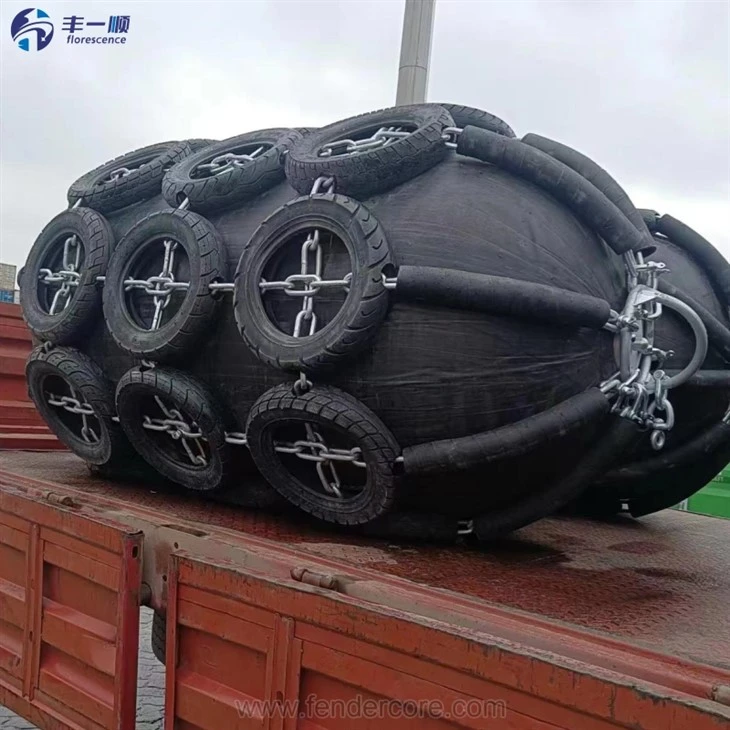
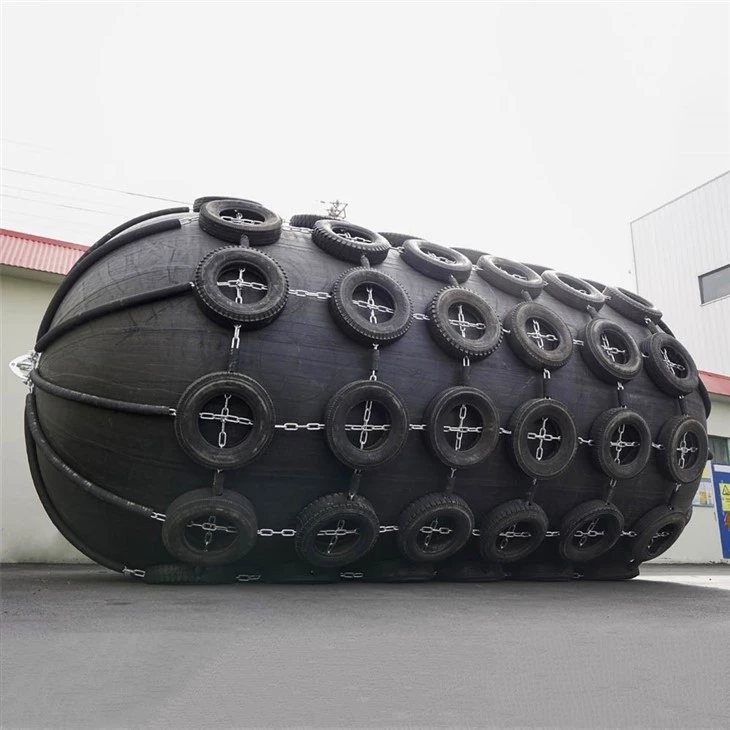
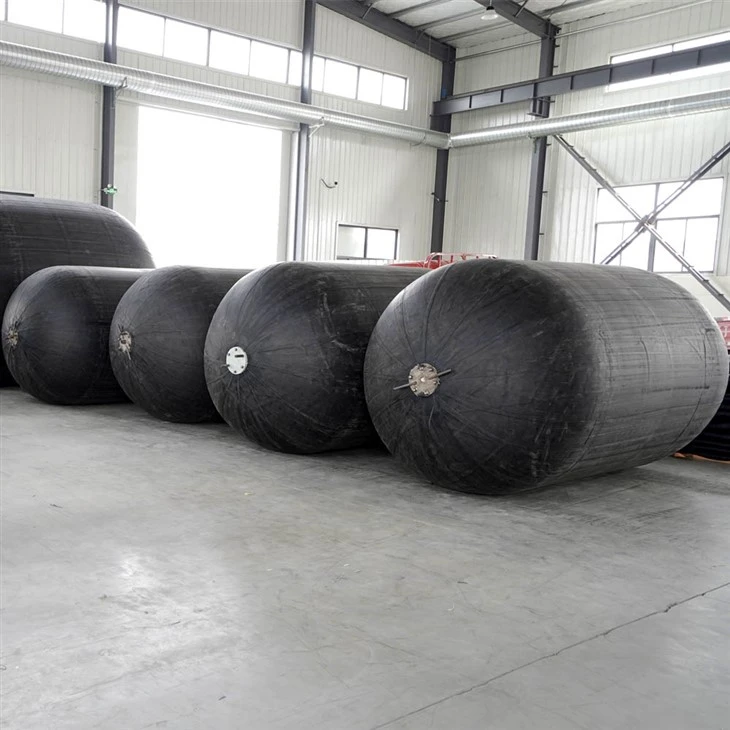
Key Product Advantages (Distinctive Features)
Advanced Winding Process: Unlike traditional molded rubber, our fenders are built using a continuous winding process, which eliminates seams and prevents structural weak points.
Proportional Energy Absorption: The energy absorption increases linearly with the deflection, allowing for a predictable and controlled docking experience.
No Performance Loss: Unlike solid rubber fenders, pneumatic fenders do not lose their energy-absorbing capabilities even when compressed at an angle.
Heavy-Duty Protective Net: Our "Chain and Tire Net" (CTN) uses galvanized high-tensile chains and specially selected heavy-duty tires to prevent the fender body from puncturing or tearing.
Rapid Deployment: Lightweight relative to its size, these fenders can be towed by small boats or lifted by cranes with ease.
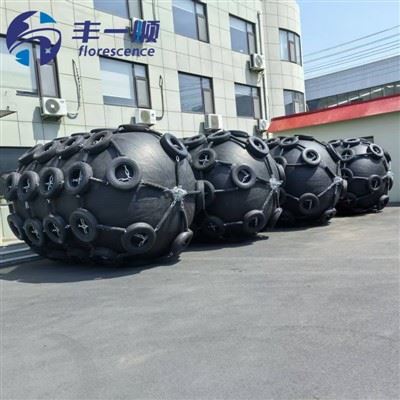
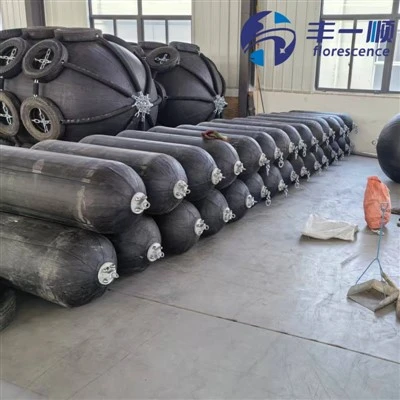
Primary Applications
Quick-Response Salvage: Used as emergency buffers for damaged vessels or during marine rescue missions.
Temporary Pier Protection: An ideal solution for berths currently under repair or for temporary docking sites.
Navy & Defense Vessels: Trusted by naval fleets for high-performance ship-to-ship refueling and logistics.
Ship-to-ship (STS) offshore transfer (tankers, LNG carriers, chemical carriers)
Ship-to-dock/jetty berthing (conventional and high tidal range ports)
Oil & gas platforms, temporary or permanent moorings
Rapid response and emergency operations
Naval vessels and liquid cargo carriers
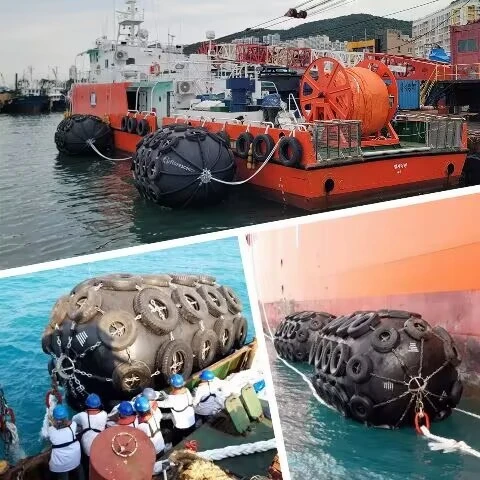
Company Insight
As a technology-driven manufacturer, Qingdao Florescence Marine Supply Co., Ltd integrates design, production, and sales. We don't just sell rubber; we provide Marine Safety Solutions. Our facility houses the largest vulcanization tanks in the region, allowing us to produce fenders up to 4.8m in diameter. With a global logistics network, we ensure that your fenders reach your port quickly, safely, and ready for immediate deployment.

Who we are.
Qingdao Florescence Marine Supply Co., Ltd is a comprehensive marine supply enterprise, integrating the scientific research design, product development with technical services since 1992.We specialize in manufacturing pneumatic rubber fenders, EVA foam fenders,various marine rubber fenders and ship rubber airbags.Florescence fenders are designed, manufactured, and tested per ISO 17357 and ISO 9001:2000 requirements. And every unit robustly built to the stringent requirements of ship surveyors such as BV,CCS, etc.
FLORESCENCE Brand is very famous in Asia, especially in Indonesia and Singapore, so we have marine airbags&fender store in Batam of Indonesia, and agent in Singapore. And we can come to your site to assist your project.

Floating Type Rubber Fender
FAQ:
1.Q: I need pneumatic fender to do ship to ship ( dock or quay ), how should I choose fender size .
A: We have many years experience in this field. If you are not sure about the size, you could provide us the ship information or your sketch, then our engineer could recommend you the suitable fender size.
2.Q: Many suppliers available, why we choose you ?
A: a. Experienced manufacturer for more than 20 years. b.High quality and competitive price. c.Professional suggestion according to your information. d.Different airbag size stock available, quick delivery e.Good raw material and cord fabric f.Do not harm the envirenment . Time&money saving.
3.Q:What is your superior advantage ?
A: Same price with high quality ; Same quality with low price.

FLORESCENCE TO BE YOUR BEST PARTNER
A: a. Company Mission: To promote the customers' sustainable growth to assist customers to become bigger and stronger, strive for country's prosperity
b.Company Vision: To become a leader in worldwide trading industry
c.Company Values: Customer-oriented, mutual benefits, honesty, responsibility

Specification of Floating Rubber Fender
|
D*L (mm) |
Initial pneumatic pressure 50KPa |
||
| Body weight(Kg) | R(KN) | GEA(KJ) | |
|
500*1000 |
25 |
64 |
6 |
|
600*1000 |
32 |
74 |
8 |
|
1000*1500 |
80 |
182 |
32 |
|
1000*2000 |
100 |
257 |
45 |
|
1200*2000 |
120 |
297 |
63 |
|
1350*2500 |
165 |
427 |
102 |
|
1500*3000 |
315 |
597 |
153 |
|
1700*3000 |
405 |
639 |
191 |
|
2000*3500 |
590 |
875 |
308 |
|
2500*4000 |
1050 |
1381 |
663 |
|
2500*5500 |
1333 |
2019 |
943 |
|
3000*5000 |
1880 |
2104 |
1210 |
|
3000*6000 |
2160 |
1583 |
1485 |
|
3300*4500 |
2020 |
1884 |
1175 |
|
3300*6500 |
2700 |
3015 |
1814 |
Floating Rubber Fender
|
Ship(DWT) |
Speed (m/s) |
Energy (KN.M) |
Fender Size(D*L) mm |
|
200000 |
0.15 |
1890 |
3300*6500 |
|
150000 |
0.15 |
1417 |
3300*6500 |
|
100000 |
0.15 |
945 |
3000*5000 |
|
85000 |
0.17 |
1031 |
3000*6000 |
|
50000 |
0.18 |
680 |
2500*5500 |
|
40000 |
0.2 |
672 |
2500*5500 |
|
30000 |
0.22 |
609 |
2500*4000 |
|
20000 |
0.25 |
525 |
2500*4000 |
|
15000 |
0.26 |
425 |
2500*4000 |
|
10000 |
0.28 |
329 |
2000*4000 |
|
5000 |
0.33 |
228 |
2000*3500 |

Floating Rubber Fender
Pneumatic fenders supplied in various standard sizes. Manufactured in accordance with the International
standard ISO 17357
1. Sizes from 0.5m diameter x 1.0m length up to 3.3m diameter x 6.5m length
2. For use in ports and ship-to-ship operations
3. Supplied as sling type (body only) or with chain and tyre net for protection of the fender body
4. High energy absorption with a low reaction force
5. Suitable for locations with large and small tidal differences

Floating Rubber Fender constructions:
Out rubber: rubber layer that covers the outside of the fender to protect the cord layers and the
inner liner rubber from abrasion and other external forces.
Inner rubber: liner of a rubber membrane that seals the pressurized air inside the fender.
Synthetic-tyre-cord layer: layer made of synthetic-tyre-cord fabric, which
maintains the internal air pressure of the fender.

types:
Net type fender: fender which is covered by a protection net consisting of either chain, wire or fibre
and usually with tyres or rubber sleeves.
Sling type fender: fender which is designed to be used without a protection
usages:
They are widely used in port, dock, shipyard, offshore platform, bridge piers, mammoth tanker,
bulk carrier, liquefied gas carrier, container ship, aluminum vessel, yacht etc.

Floating Rubber Fender FAQ,
Q1: Will the air pressure drop during use? How often does it need refilling?
A: Thanks to the high-quality air-tight inner rubber and vulcanized seam, pressure loss is very slow under normal use. It is recommended to check pressure every 3–6 months – refill if pressure drops more than 0.02MPa below initial value. For harsh sea conditions or high-frequency use, shorten the interval to 2 months.
Q2: Are tire nets and chains standard accessories? What is their purpose?
A: Tire nets and chains are optional protective accessories, not required for all conditions. When fitted over the pneumatic fender, they serve to: ① resist cuts from sharp objects (e.g., damaged hull plates, rocks); ② extend fender service life; ③ facilitate lifting and towing. For clean water and smooth hulls, tire nets are not necessary.
Q3: Can the fender be repaired if the outer surface is damaged?
A: Small scratches on the outer rubber (not reaching the cord layer) can be repaired on-site using special cold repair glue or vulcanizing patch kits. If the cord layer is exposed or the fender leaks air, it requires hot vulcanization repair back at the factory. Severe damage should be replaced directly to ensure safety.
Q4: How does performance change in extreme cold (-30℃) or hot (+50℃) environments?
A: Our fenders use low-temperature/high-temperature resistant rubber compounds. Within -30℃ to +50℃, they maintain good elasticity. At low temperatures, rubber becomes slightly stiffer – initial reaction force increases by approx. +10~15%. At high temperatures, rubber is more flexible – reaction force decreases slightly. Energy absorption variation remains within ±5% – core protection function is not compromised.
Q5: How do I determine the required fender size and quantity?
A: The following information is needed: ① Vessel tonnage (DWT) or displacement; ② Berthing speed (m/s); ③ Dock structure type; ④ Tidal range; ⑤ Maximum allowable reaction force. FLORESCENCE can provide berthing energy calculation and selection recommendations based on these parameters to help you choose the optimal size and quantity.
Q6: What quality tests are performed before shipment?
A: Each fender undergoes: ① Air-tightness test (inflate to 0.1MPa, hold pressure for 24 hours with no drop); ② Visual and dimensional inspection; ③ Sampled vulcanization quality test (cord adhesion strength, rubber tensile/tear strength); ④ Safety valve function test (if equipped). A test report is provided with each shipment.
Hot Tags: floating type rubber fender, China, suppliers, manufacturers, factory, price, fpso pneumatic fender with tire, pneumatic fender tire gauge


