


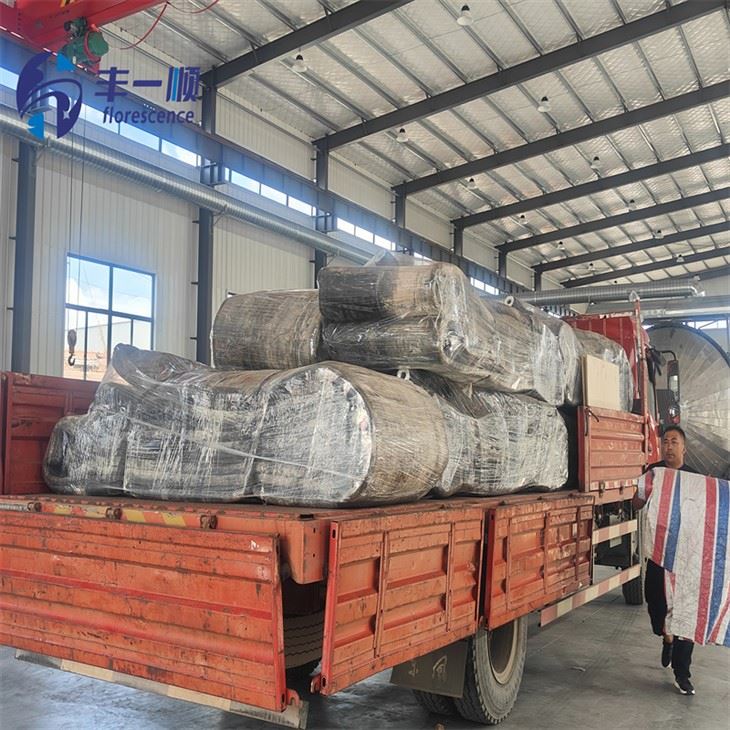

Marine Rubber Airbag
Florescence rubber airbags are specialized heavy-duty inflatable devices made of rubber and reinforced synthetic cord layers, engineered primarily for maritime buoyancy, lifting, and floating applications. Unlike standard ship launching airbags that focus on rolling vessel movement, their core design prioritizes superior buoyancy to support flotation, salvage, and marine engineering tasks.After 26 years" accumulation and sediment, our Marine Rubber Airbags are the products of accurate engineering and technology that witness high-quality & flexible rubber material has gone through delicate cord layering manufactuing and innovative advancement.

Material and Structure
Our Rubber Airbags are composed by airbag body and terminal iron part.The airbag body is consisted of natural rubber and synthetic-cord-reinforced rubber layers through vulcanization processing;
The terminal iron part is made of cast iron, it is combined closely with the bag body; One end is for pulling when move the airbag, and the other end is for charging and discharging the air. All the fittings in the above picture will be supplied with airbags for free.
The outer rubber layers can protect the cord layers from abrasion and other external forces. The Airbags have sufficient tensile and tear strength to withstand strict weather and situation.

Ship launching/landing/salvage/heavy lifting using Rubber Airbags is a very popular vessel launching method , particularly in marine operations. It is much important to choose the right size for safety and efficiency.
Identitying the type ,size & weight of the vessel. Main factors like types, the length, width and weight ,depth of water.
We can customize many different airbags sizes according to clients' request.

Here are our Airbags size range:
|
Ship Rubber Airbag |
Diameter |
Effective Length(m) |
Number of Cord Layers |
|
Qualification |
0.6 - 2.8 m |
5 - 24 m |
3-12 |
Our Rubber Airbag can be widely used and help users to save effort, time, work load and investment.
①Ship hauling & launching
②To mobilise massive structures
③To Salvage rescue process
④For erecting floating brige or pipeline
⑤For ship upgrading,conversion or repair launching
⑥For hoisting and transporting heavy structures
⑦For Salvaging sunken ship or heavy immersed steel structure
⑧Rubber bag for ship ballast

Here are some key steps involved in the inspection of ship launching airbags before shipping:
1 Visual Inspection: The inspector will visually inspect the entire airbag for any visible damage or defects. This includes checking for tears, punctures, or any other signs of wear that could compromise the airbag's structural integrity.
2 Inflation Check: The airbag will be inflated to ensure that it is capable of holding air and maintaining its shape. The inspector will look for any leaks or areas where air is escaping.
3 Valve and Connection Inspection: All valves and connections on the airbag will be checked to ensure they are secure and functioning properly. This includes verifying that any quick-release mechanisms are operable and in good condition.
4 Pressure Testing: The airbag may undergo pressure testing to ensure it can withstand the forces it will encounter during the ship launch. This testing involves gradually increasing the internal pressure of the airbag to simulate the stress it will experience during use.
5 Documentation: The inspection results will be thoroughly documented, including any issues or concerns identified. This documentation is crucial for future reference and can be used to inform maintenance or replacement decisions.

FAQ
Q1: How do you repair a ship airbag if it gets punctured or gouged?
A1: Minor surface damage can be fixed using our three-layer hot-vulcanization repair kits, which restore full airtightness and cord layer integrity.
Q2: What are the standard diameters available for vessel dry-docking?
A2: The most widely used diameters for commercial vessel dry-docking and launching are 1.5m and 1.8m, balancing lifting height with structural stability.
Q3: Are your marine airbags certified by third-party ship classification societies?
A3: Yes. We provide witness-testing and product certificates issued by Bureau Veritas (BV), China Classification Society (CCS), and American Bureau of Shipping (ABS).
Q4: What accessories are included in a standard marine airbag kit?
A4: A standard kit includes pressure gauges, air inlet valves, sealing end-flanges, pulling rings, and specialized inflation hoses.
Q5: How should ship airbags be stored when not in use for long periods?
A5: They should be cleaned, deflated completely, and stored in a cool, dry, well-ventilated indoor warehouse, away from direct sunlight, heat sources, and oils.
|
Brand |
Florescence |
|
Product name |
Ship launching airbag |
|
Material |
Natural rubber |
|
Certificate |
BV, ABS, CCS, ISO 14409,LC |
|
Diameter (D): |
From 0.6m to 2.8m |
|
Effective Length (EL): |
From 5.0m to 28.0m |
|
Total Length (TL): |
From 7.0m to 31.0m |
|
Standard Number of Layers: |
Usually 3-12 layers |
Hot Tags: ship landing and launching rubber airbags with high-quality, China, suppliers, manufacturers, factory, price, vessel launching coastal equipment, ship launching durable airbag, shipbuilding launching airbag, marine airbag for portable launching, boat building flexible launching system, boat launching safety cushion


