

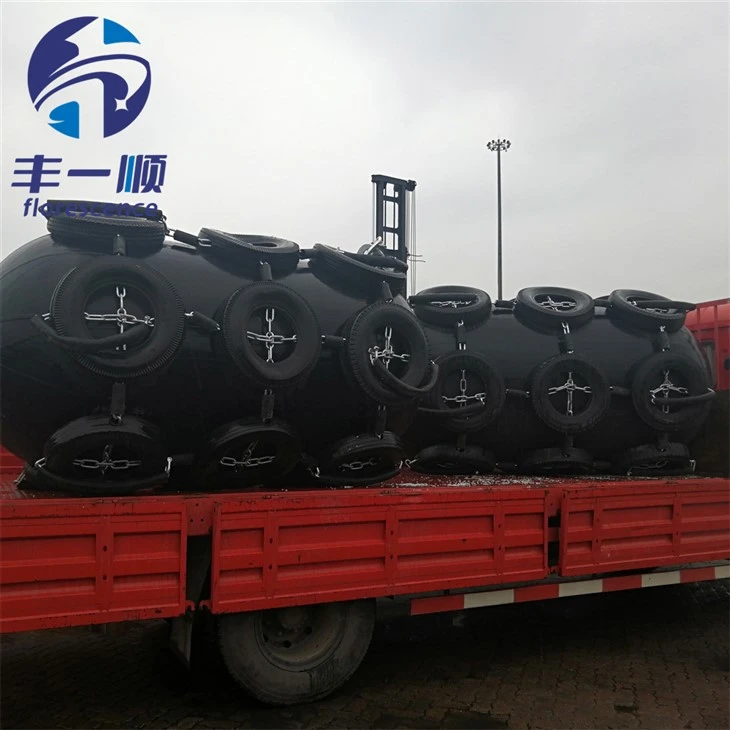


High-Performance Yokohama Pneumatic Rubber Fenders

Product Overview & Core Classifications
FLORESCENCE Yokohama Pneumatic Rubber Fenders are premier, high-strength marine berthing systems designed to absorb heavy kinetic energy during ship-to-ship (STS) transfers and vessel-to-dock mooring operations. Utilizing the natural elasticity of compressed air, these floating rubber fenders provide a highly adaptive, progressive load-deflection profile that shields ship hulls and port infrastructures from structural damage.
To meet varying operational environments, logistics weights, and hull sensitivity requirements, our pneumatic fenders are categorized into two primary functional configurations:
Net-Type Pneumatic Fenders: Enclosed in a heavy-duty protective lattice network (netting) paired with recycled vehicle tires and thick vulcanized rubber sleeves. The net acts as an external sacrificial armor layer, absorbing severe frictional wear, preventing localized punctures, and distributing shear loads evenly across the fender body.
Sling-Type Pneumatic Fenders: Formulated solely as a streamlined, high-grade rubber fender body without an external chain net. Fitted with heavy-duty end pulling rings, sling-type fenders are exceptionally lightweight, portable, and easy to deploy, making them the ideal non-marking solution for sensitive naval defense hulls and fast-response operations.

Breakdown of Protective Netting Solutions
For our Net-Type Fenders, FLORESCENCE offers three specialized netting material options tailored to distinct maritime deployment challenges:
Chain Nets: Constructed from heavy-duty, hot-dip galvanized steel chains. This network delivers superior resistance to saltwater corrosion and extreme abrasion, making it the industry standard for permanent dock installations and rough open-ocean lightering.
Wire Nets: Built using high-tensile steel wire ropes. This option provides a significantly lighter overall weight profile compared to chain nets, making the fenders easier to hoist, maneuver, and repair on-site.
Fiber Nets: Formulated using high-durability synthetic fiber webbing paired exclusively with protective rubber sleeves (without heavy tires). This configuration minimizes total weight and completely eliminates the risk of hull scraping, making it highly recommended for luxurious cruise liners and yacht terminals.

Performance & Dimensions Matrix (Popular Sizes)
Our pneumatic rubber fenders are engineered and validated across a broad dimensional envelope, spanning diameters from 0.3m to 4.5m and lengths from 0.6m to 9.0m. Below are the performance metrics for our most widely specified standard configurations:
| Fender Diameter (m) | Fender Length (m) | Reaction Force (KN) | Energy Absorption (KJ) |
| 0.6 | 1.0 | 74 | 8 |
| 1.2 | 2.0 | 297 | 63 |
| 1.5 | 3.0 | 579 | 153 |
| 2.5 | 4.0 | 1381 | 663 |
| 3.3 | 6.5 | 3015 | 1814 |
| 4.5 | 6.5 | 4150 | 3426 |
Remark: FLORESCENCE provides full engineering support for custom non-standard dimensions, specialized length ratios, and targeted pressure optimizations tailored to your project criteria.
Strategic Applications & Field Deployment
FLORESCENCE pneumatic systems are globally deployed across a versatile array of heavy-duty industrial and defense sectors:
Supertankers & Bulk Carriers: Safe separation buffers for Very Large Crude Carriers (VLCCs), LNG tankers, and massive ore carriers.
Commercial Container Vessels: Reliable standoff protection during high-frequency container terminal berthing.
Offshore Sea-Task Platforms: Heavy-impact cushioning for oil rigs, floating production units (FPSOs), and marine construction barges.
Large Shipyards & Dry Docks: Essential infrastructure for vessel construction, launching, and repair positioning.
Commercial Cruise Liners: Gentle, non-marking berthing protection for large passenger cruise ships.
Military Harbor Docks: High-specification ground tackle solutions satisfying strict naval safety and stealth protocols.
Bridge Pier Protection: Structural collision barriers installed around marine bridge foundations to prevent catastrophic ship impacts.
Corporate Advantage & Quality Mandate
34+ Years of Manufacturing Leadership: Serving the global maritime industry continuously since 1992 with deep technical expertise.
Comprehensive IACS Class Certifications: Fully audited and certified by premium global classification societies, including BV, CCS, ABS, and GL (DNV).
Strict Standard Compliance: All design, raw material testing, and manufacturing phases comply with the rigorous requirements of ISO 17357 manufacturing standards.
Elite Service Lifespan & Warranty: Engineered with proprietary anti-aging compounds to guarantee a working lifespan exceeding 10 years, backed by an industry-leading 2-year factory warranty.
Rapid Global Dispatch Turnaround: We maintain an active inventory pipeline of popular standard dimensions, enabling guaranteed shipping dispatch within 3 days for urgent emergency port orders.
Engineering & Operational FAQ
Q1: What are the main functional tradeoffs between a Chain Net and a Wire Net on a pneumatic fender?
A: The choice depends heavily on your handling equipment and maintenance access. Chain nets utilize thick, galvanized links that offer maximum resistance to structural abrasion and corrosion over a 10-year lifespan, making them ideal for fixed dock positions or rugged ship-to-ship transfers. However, they add substantial weight to the fender assembly. Wire nets utilize high-tensile wire cables, offering a lighter, more flexible configuration that simplifies crane handling and hoisting. While wire ropes require more frequent visual monitoring for localized fraying, they can be rapidly spliced and repaired on-site without complex welding.
Q2: Why does FLORESCENCE provide an extended 2-year warranty on its pneumatic fenders compared to the standard 1-year industry average?
A: Our ability to provide a 2-year factory warranty stems from our strict raw material validation and advanced vulcanization processes. We utilize high-purity natural rubber mixed with proprietary anti-aging stabilizers and cross-directional, multi-layer synthetic tire cords. This composite matrix maintains high structural integrity under continuous cyclic compression and harsh UV exposure, minimizing the risk of pressure drops or microscopic leaks.
Q3: How do pneumatic fenders adapt to ports experiencing extreme vertical tidal ranges?
A: Unlike fixed solid rubber fenders, which can become submersed or completely bypassed during low or high tides, pneumatic fenders are naturally buoyant. They float directly on the water's surface and rise or fall autonomously alongside the shifting water line. This guarantees that the protective buffer remains perfectly aligned with the vessel's widest beam at all times, maintaining a constant safe standoff distance regardless of the tidal stage.
Q4: How do pneumatic rubber fenders perform during inclined or angled berthing maneuvers compared to solid rubber alternatives?
A: Solid rubber fenders experience a sharp decline in energy absorption and face high shear stress when compressed at an angle. Pneumatic fenders excel in angled berthing (up to 15°) because the compressed air shifts dynamically within the rubber body. This internal air redistribution maintains uniform contact pressure across the hull plating and prevents localized stress concentrations, ensuring safe energy dissipation even during imperfect approaches.
Q5: What safety mechanisms prevent a pneumatic fender from bursting if it experiences accidental, severe over-compression?
A: To prevent catastrophic structural failure during extreme over-berthing events, all FLORESCENCE pneumatic fenders with diameters of 2.5 meters and larger are equipped with an integrated, certified safety release valve. When a vessel's impact forces compression beyond the safe limit (typically exceeding 60% deflection), the internal pressure spikes dangerously. The safety valve automatically opens to vent excess air, instantly lowering internal stress and protecting the high-tensile tire-cord hull matrix from bursting.
Q6: How should port operators adjust internal pressure to account for extreme regional or seasonal temperature fluctuations?
A: Internal pressure is directly proportional to ambient temperature. A fender inflated in cold climates will experience a pressure drop in winter and a significant pressure spike when deployed in tropical regions or under intense, direct summer sunlight. We recommend performing quarterly pressure checks. If the internal pressure deviates by more than 10% from its nominal rating (50 kPa or 80 kPa) due to climate shifts, air should be bled or added via the valve assembly to prevent over-stretching the rubber skin or compromising energy absorption performance.

Hot Tags: florescence yokohama rubber marine fenders for ship, China, suppliers, manufacturers, factory, price, fpso pneumatic fender with tire, pneumatic fender tire gauge
