


Introduction of ship lift airbag
Boat lifting airbags, basic body consists of rubber layers, synthetic-cord-reinforced rubber layers, which are cylindrical airbags with hemispherical heads at the both ends. All of these are vulcanized together, and then compress air inside to enable in to roll.
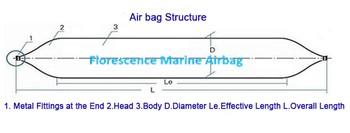
Features of boat launching airbags
- Inner diameter of the airbag / cylindercal bag 500 to 2800 mm;
- Length of the cylindrical part, 3 000 to 25000 mm;
- Maximum working pressure in the airbag, 0.4 to 4 kg / cm2 ;
- Maximum weight carrying capacity of the airbag, 6 to 800 tons;
- Number of cord layers 3 to 14 layers ;
- Operating temperature range from - 10° C to + 60 ° C .

Materials of ship launching airbags
An airbag is to be constructed of an outer rubber layer, one or more synthetic-tyre-cord layers, and an inner rubber layer. The arrangement of synthetic-tyre-cord reinforcement layers is shown in the picture below, all materials shall be vulcanized firmly.
Prior to the airbag production, the outer and inner rubber layers shall be tested to meet criteria in the following table in accordance with the test methods given in the international standard list in the table.
While only one satisfactory sample per batch is required for test numbers 1 through 3, all others must be tested for test numbers 4 through 9 annually. If the first sample fails, two additional sample should be tested. If the additional samples pass the test requirements, the materials will be deemed to have passed the test. Otherwise, the materials will be deemed to have failed the test and another batch of materials shall be selected.

How to use airbag to salvage ship:
1. What equipments are needed to install / securing / inflate the air bags(for salvage)?
You will need diver to go under the water(install); and tie our deflated airbags with rope or net to the bottom of your ship(securing);then inflate the airbag with air compression machine linked by rubber hose on the land(inflate ).
2. What is our warranty?
We can assure clients that we could lift ships as your request, as long as we get enough proper information of the project and the ships are not too deep.
Besides the airbags, we can design suitable solution for your projects and provide any equipments that are need during the salvage, including rope or rope net, winch, rubber tube and air compression machine, etc.
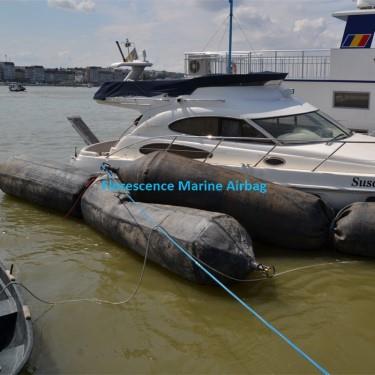

Guaranteed working pressure of boat lift air bags
Type | D=0.8m | D=1.0m | D=1.2m | D=1.5m | D=1.8m | D=2.0m |
3 layers | 0.13MPA | 0.10MPA | 0.09MPA | 0.07MPA | 0.06MPA | 0.05MPA |
4 layers | 0.17MPA | 0.13MPA | 0.11MPA | 0.09MPA | 0.08MPA | 0.07MPA |
5 layers | 0.21MPA | 0.17MPA | 0.14MPA | 0.11MPA | 0.09MPA | 0.08MPA |
6 layers | 0.25MPA | 0.20MPA | 0.17MPA | 0.13MPA | 0.11MPA | 0.10MPA |
7 layers | 0.29MPA | 0.23MPA | 0.20MPA | 0.15MPA | 0.13MPA | 0.12MPA |
8 layers | 0.33MPA | 0.26MPA | 0.23MPA | 0.17MPA | 0.15MPA | 0.14MPA |
Working principle of rubber airbag
Through filling the compressed air to produce buoyancy, then using buoyancy to salvage. It's easy, safe and reliable operation.
In addition to hang a ship in a fixed position or connected with lifting jack of the bottom of ship, ship lifting airbag also can be placed inside the ship cabin, through filling out the cabin water to provide buoyancy.

Storage of boat lifting airbags:
The airbags should be maintained in a dry ventilated room and be protected from light.
The airbags should be in a relaxed condition free from tension, compression or other deformation.
The airbags should be kept away from any heat source.
The airbags should be protected from acids, alkalis, oils or organic solvents.
How to choose suitable vessel lift airbags
1. Pls provide sunken ship length,width and weight.
2. How long and how many meters has the ship sank.
3. How's the underwater condition, rocks,mud,sand or other.
4. If possible, pls send site condition to us.


Hot Tags: boat lift air bags, China, suppliers, manufacturers, factory, price, airbag express cost, airbag assessment, airbag freight cost, airbag return policy, airbag research cost, airbag regulations


