

Hey there! As a foam fender supplier, I often get asked about all sorts of technical stuff related to our products. One question that comes up quite a bit is, "What is the Poisson's ratio of a foam fender?" So, let's dive right into it and break it down in a way that's easy to understand.
First off, what the heck is Poisson's ratio? Well, it's a measure of how a material behaves when it's being squeezed or stretched. When you push on a material, it doesn't just get shorter in the direction you're pushing. It also gets wider in the directions perpendicular to the push. Poisson's ratio is the ratio of this lateral strain (the change in width) to the axial strain (the change in length).
For a foam fender, Poisson's ratio is super important. You see, foam fenders are used to protect boats and docks from impacts. When a boat hits a fender, the fender gets compressed. If the Poisson's ratio is too high, the fender will expand too much in the sides when it's compressed, which could lead to it getting damaged or not performing as well. On the other hand, if the ratio is too low, the fender might not be able to absorb the impact energy effectively.
Now, the Poisson's ratio of a foam fender can vary depending on a few factors. The type of foam used is a big one. Different foams have different internal structures, which affect how they respond to compression. For example, a closed - cell foam might have a different Poisson's ratio compared to an open - cell foam. Closed - cell foams are generally more resistant to water and have a more uniform structure, which can lead to more predictable Poisson's ratio values.
The density of the foam also plays a role. Higher - density foams usually have a lower Poisson's ratio. This is because the cells in a high - density foam are more closely packed, and there's less room for the foam to expand laterally when compressed. So, if you need a fender that won't expand too much on the sides when hit, a high - density foam might be a good choice.
Another factor is the manufacturing process. How the foam is made can affect its internal structure and, therefore, its Poisson's ratio. For instance, if the foam is molded under high pressure, it might have a different ratio compared to a foam that's made through a more relaxed process.
In general, the Poisson's ratio of a foam fender typically ranges from around 0.1 to 0.5. But this is just a rough estimate, and the actual value can be different for each specific product. That's why we, as foam fender suppliers, do a lot of testing to make sure our fenders have the right Poisson's ratio for their intended use.
Let's talk about some of the different types of foam fenders we offer and how Poisson's ratio might come into play.
We have Foam Boat Fender. These are designed to protect boats from impacts when they're docking or mooring. For these fenders, we want a Poisson's ratio that allows them to absorb the energy of the impact without expanding too much. This way, they can fit nicely along the side of the boat and not cause any interference.
Our Buoy Foam Fender is used in a marine environment where it needs to withstand the constant movement of the water and potential impacts from boats. The Poisson's ratio here is crucial to ensure that the fender can maintain its shape and functionality over time. A well - balanced Poisson's ratio helps the fender to absorb the energy from the waves and impacts without getting damaged easily.
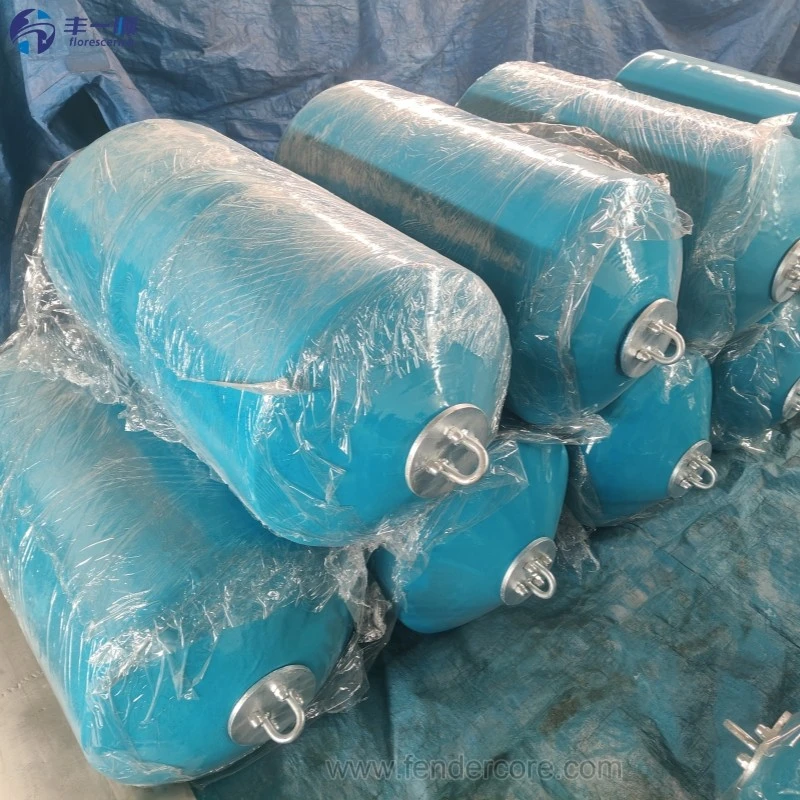
Then there's the Florescence Polyurethane Foam Filled Fender D1.2L2.0m Popular Size For Dock. These fenders are used at docks to protect the dock structure from boat impacts. The Poisson's ratio of the foam filling is carefully selected to ensure that the fender can handle the force of a boat hitting the dock. It needs to compress in a way that spreads the impact energy evenly and doesn't cause excessive lateral expansion.
So, why does all this matter to you, the customer? Well, if you're in the market for a foam fender, understanding Poisson's ratio can help you make a more informed decision. You can ask us about the Poisson's ratio of the fenders you're interested in and how it might affect their performance.
If you need a fender that will be in a tight space, you might want one with a lower Poisson's ratio to minimize lateral expansion. On the other hand, if you need a fender that can absorb a lot of energy from a big impact, a fender with a slightly higher Poisson's ratio might be better, as long as it's within a reasonable range.
At the end of the day, we're here to make sure you get the right foam fender for your needs. Whether you're a boat owner, a dock operator, or someone in the marine industry, we have the expertise to help you choose the perfect fender.
If you're interested in learning more about our foam fenders or have any questions about Poisson's ratio or other technical aspects, don't hesitate to reach out. We'd love to have a chat with you and discuss your requirements. We can also provide you with detailed product information and specifications to help you make the best decision.
So, what are you waiting for? Contact us today and let's start the conversation about getting you the ideal foam fender for your situation.
References

- "Foam Materials and Their Properties" - A textbook on foam materials
- "Marine Fender Design and Performance" - Research paper on the design and performance of marine fenders